Newsletter Subscribe
Enter your email address below and subscribe to our newsletter
Enter your email address below and subscribe to our newsletter

 ByJohn A
Every tennis player knows the frustration: you buy a ball machine with grand plans of dawn practice sessions, then discover that lugging a 60-pound box to the court is a workout you never signed up for. Within a month, the machine lives in your garage, and your backhand is no better than it was. Portability is not a nice-to-have. It is the feature that decides whether you actually use the machine.
The logic is simple. A machine you can carry to the court with one hand, roll across the parking lot, and set up in ninety seconds gets used three times a week. A machine that needs a dolly, a friend, and a chiropractor gets used three times a year. Before you compare ball speed or spin settings, ask the most important question: can I actually get this thing to the court without dreading it?
The single most honest specification on a ball machine is its weight, and it deserves to be the first number you check. Anything under 25 pounds is genuinely portable — you can lift it with one hand and carry it from the parking lot to the baseline without stopping. Machines in the 25-to-40-pound range are manageable but get noticeably awkward over any real distance. Anything over 40 pounds crosses a line: you will start making excuses.
Modern portable designs cut weight with compact brushless motors, lightweight composite housings, and batteries integrated into the chassis. Check whether the listed weight includes the battery and remote — some spec sheets quietly leave those out, and a “19-pound” machine can be a 26-pound machine once fully loaded. A practical rule: if you cannot lift it from the ground into your trunk in one smooth motion, you will skip sessions.
Weight is only half of the portability equation. The other half is how the machine moves once it leaves your hands. Good wheels turn a 35-pound machine into something that feels effortless; bad wheels turn a 25-pound machine into a chore. Look for oversized wheels with real tread — not the hard plastic casters that rattle apart on asphalt and jam on the slightest crack.
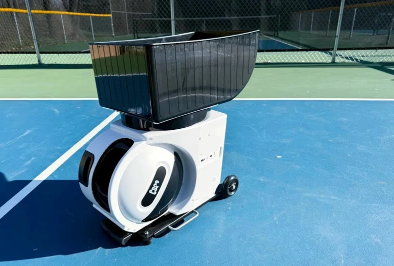
Choosing a portable tennis ball machine with a proper wheeled base changes how you set up: instead of carrying the machine to the baseline and lifting it into position, you roll it straight onto the court, flip it upright, and you are feeding balls within minutes.
A single top handle is fine for short carries, but for longer walks a balanced grip point that keeps the machine level saves your wrist and your back. If your courts are up a hill or stairs, prioritize a model whose center of gravity sits low when carried — a top-heavy machine sways and fights you with every step.
The heaviest thing on old ball machines was often not the machine at all — it was the lead-acid battery, sometimes weighing as much as the launcher itself. Modern lithium batteries changed the math entirely. A current-generation lithium pack delivers two to four hours of continuous feeding at a fraction of the weight, and drops the total package into the genuinely portable zone.
When evaluating battery claims, look past the headline hours. Manufacturers typically quote runtime at the lowest speed setting, which almost nobody uses for real practice. A machine rated for “4 hours” at minimum speed may deliver closer to 90 minutes at match-realistic speeds with oscillation and spin running — still plenty for a focused session, since most players hit a physical wall long before the battery does.
Two features separate thoughtful designs from frustrating ones. The first is a removable battery: if you can pop the pack out and charge it indoors, you avoid dragging the whole machine to an outlet, and a spare pack doubles your court time. The second is fast charging — a battery that tops up in two hours instead of six fits naturally into a morning-of routine. A lightweight tennis trainer built around a removable lithium pack stays genuinely carry-able while delivering the runtime a serious solo session demands.
Before you commit to any machine, run through this quick evaluation. It takes five minutes and will save you from the garage-fate that claims so many ball machines.
There is a deeper reason portability matters beyond convenience: frequency beats intensity in skill development. Short, frequent practice sessions build muscle memory far more effectively than occasional marathons. A machine you grab twice a week for 45 minutes of footwork drills will do more for your game than a heavyweight that comes out once a month for a two-hour slog — and a truly carry-able machine fits those sessions into the margins of a busy week, no hitting partner required.
Choosing a tennis ball machine is really choosing a habit. Every extra pound, every fiddly assembly step, and every dead battery quietly subtracts from the number of times you will practice. The players who improve are not the ones with the most powerful machine — they are the ones whose machine is easy enough to grab that skipping a session feels like the harder option.