Newsletter Subscribe
Enter your email address below and subscribe to our newsletter
Enter your email address below and subscribe to our newsletter

 ByJohn A
For many beginner and intermediate pianists, traditional sheet music can feel unnecessarily dense. Seeing every single bass note, harmony, and rhythm written out note-for-note on two staves takes time to decipher and leaves little room for personal creativity.
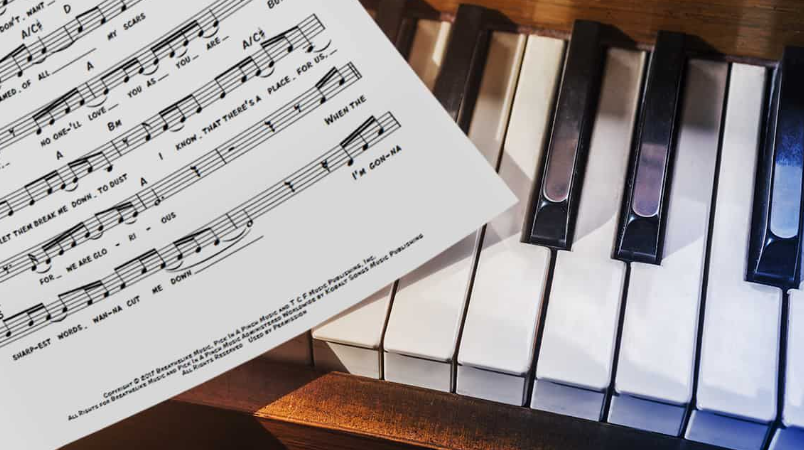
If you have ever watched a pop, jazz, or rock pianist sit down and casually play complex songs without a thick book of classical arrangements in front of them, chances are they were reading a lead sheet. A lead sheet is the ultimate musical blueprint: it provides just enough information to guide you through a song while giving you the freedom to create your own accompaniment patterns.
Unlike full grand staff sheet music, which includes both treble and bass clefs with exact notes for both hands, a lead sheet is streamlined. It consists of three core elements:
Because a lead sheet omits the bass clef entirely, the pianist’s left hand is given complete freedom. Instead of reading pre-written bass notes, you use the chord symbols above the staff to decide how to build your left-hand bass lines, block chords, or arpeggiated patterns.
The real magic of playing from a lead sheet lies in understanding how to translate chord shorthand into rich sounds under your fingers. While the melody line tells your right hand what to play, shorthand labels show both hands what harmonies to build around that melody.
Learning to read chord designations efficiently is a fundamental skill for any pop or jazz musician. Basic symbols start simple:
If you are new to interpreting these musical shorthands, studying a detailed guide on piano chord symbols can help you quickly identify chord structures and root positions on the keys without slowing down your reading speed.
Beyond notes and harmonies, a lead sheet acts as a roadmap for the entire piece. Because lead sheets are designed to save space—often fitting an entire four-minute song onto a single page—they rely heavily on structural navigation symbols.
When scanning a lead sheet, look for these common structural markers:
Understanding how these navigational cues work ensures you stay in sync with other musicians or backing tracks without getting lost mid-performance. For a step-by-step breakdown of how to follow these roadmaps smoothly, learning how to read a piano lead sheet will help you decipher structural markers alongside melody lines with ease.
Once you can read the melody and identify the chords, the next step is choosing how to arrange the song at the keyboard. Since the lead sheet does not tell you how to play the chords, you can adapt your playing style to match the genre or mood of the song.
Here are three popular ways beginners can arrange lead sheet chords:
As you become more comfortable, you can mix and match these approaches, adding rhythm variations, syncopated beats, and fills to make the arrangement uniquely your own.
Reading a lead sheet is one of the most liberating skills a pianist can acquire. By moving away from rigid note-for-note arrangements and focusing on the core relationship between melody, chords, and structure, you gain the freedom to play hundreds of popular songs with confidence. Whether you want to accompany a singer, play in a band, or simply sit down and arrange your favorite pop tunes on the fly, lead sheets provide the perfect balance of guidance and creative flexibility.